Commercial Fire and Water Damage Restoration: Gainesville, GA
Location: Gainesville, GA
Type of Loss: Commercial fire, smoke, and sprinkler water damage
Response Time: Within 90 minutes
Affected Area: Approximately 100,000 square feet
Urgent Mitigation Timeline: Friday evening through Sunday
Smoke and Fire Treatment Timeline: Approximately 2 weeks
Provision’s Team Size for this Project: 20 Specialists
The Situation: An Electric Golf Cart Fire Inside a Large Warehouse
One Friday afternoon, our team was called to a large commercial warehouse in Gainesville after an electric golf cart caught fire inside the facility.
The building’s sprinkler system activated, which helped control the immediate fire risk. That was obviously a good thing, but once the sprinklers went off, the property owner was left with a second major problem: a large amount of water drenched parts of the warehouse and nearby office areas.
That’s something we’ve found that many business owners don’t expect. With a commercial fire loss, the fire itself is only one part of the problem. Once the flames are out, there can still be sprinkler water, wet flooring, soaked walls, smoke odor, fire residue, affected personal belongings, and business interruptions that all need to be handled quickly, otherwise the costs can quickly multiply.
In this case, the affected area was approximately 100,000 square feet. That’s a massive area: the equivalent of forty 2,500 square foot houses - an entire neighborhood! So you can understand that this wasn’t a small cleanup job. It was a huge commercial loss that needed immediate response, a large, experienced crew, specialized drying equipment, fire and smoke treatment, custom-built containments, and careful coordination with everyone involved.
The customer heard about Provision Property Restoration through word of mouth and contacted us right after everything happened on that Friday afternoon. Because of the size and urgency of the loss, the project was escalated right away to our upper management. Tim, one of Provision’s co-founders, arrived at the property with a large team just 90 minutes after the call, ready to begin emergency water extraction and mitigation.
Why Fast Response Matters After a Commercial Fire and Water Damage
Like we mentioned above, when a fire happens inside a building, the damage doesn’t stop once the fire is out.
The sprinkler system may have done exactly what it was designed to do, but the water from that system can spread quickly. It’ll easily soak into flooring, walls, offices, furniture, equipment, personal contents, and the building structure.
Another important factor was the type of water involved. This wasn’t simply clean water from a fresh household tap. Fire sprinkler systems can release water that has been sitting in the lines for a long time, so it can carry rust, sediment, odor, or other materials from inside the piping. That’s one reason professional extraction, demolition where needed, drying, and air treatment were important on this fire damage restoration project.
At the same time, smoke can move far beyond the original fire area. It can settle onto walls, ceilings, surfaces, and materials that were not directly burned. If odor and smoke residue aren’t treated correctly, the smells and other effects can linger for a long time after the fire itself has been put out.
So instead of dealing with one issue, the property owner was suddenly dealing with multiple things all at once:
Fire damage
Smoke damage
Smoke odor
Sprinkler water damage
Wet flooring
Wet wall materials
Affected office areas
Water throughout the warehouse
Furniture and contents that needed to be moved
Business interruption concerns
A large affected area that needed to be stabilized quickly
For a warehouse this size, speed matters. Every hour that water sits can increase the amount of damage. Every hour that smoke odor remains untreated can make the cleanup more involved. And for a business, every hour of disruption can create added stress for the owner, employees, and operations.
This project definitely needed more than a small crew and a few fans. It required a large-loss response with experienced people, sufficient commercial-grade equipment, and a strong plan from the very beginning.
Emergency Commercial Fire Damage Response in Gainesville
Our 90 minute response time allowed us to get there while the fire department was still there, so we were able to collaborate with the firefighters and warehouse owner. They explained what happened and where the damage was, so we could quickly get to work focusing on those areas, stabilizing the property and keeping the damage from getting worse.
That initial conversation is always a major factor in any project we do. On a large commercial loss like this one, there are usually several moving parts at the same time. The property owner needs answers, and likely doesn’t know the details of what’s required next. The fire department may still be on-site and working. Employees or staff may need to be kept away from affected areas. The restoration team needs to determine where work can safely begin. And the building itself needs to be protected from additional damage.
Once we had approval, work began right away that afternoon.
Identifying the Damage and Building the Work Plan
Our initial assessment focused on:
Confirming where the fire started
Identifying where sprinkler water had spread
Inspecting affected office, bathroom, and kitchen areas
Evaluating flooring and wall materials
Looking for areas that needed demolition
Identifying smoke and fire-affected surfaces
Planning containment areas
Preparing for large-scale drying
Coordinating access for a large crew
Separating affected warehouse areas from interior spaces
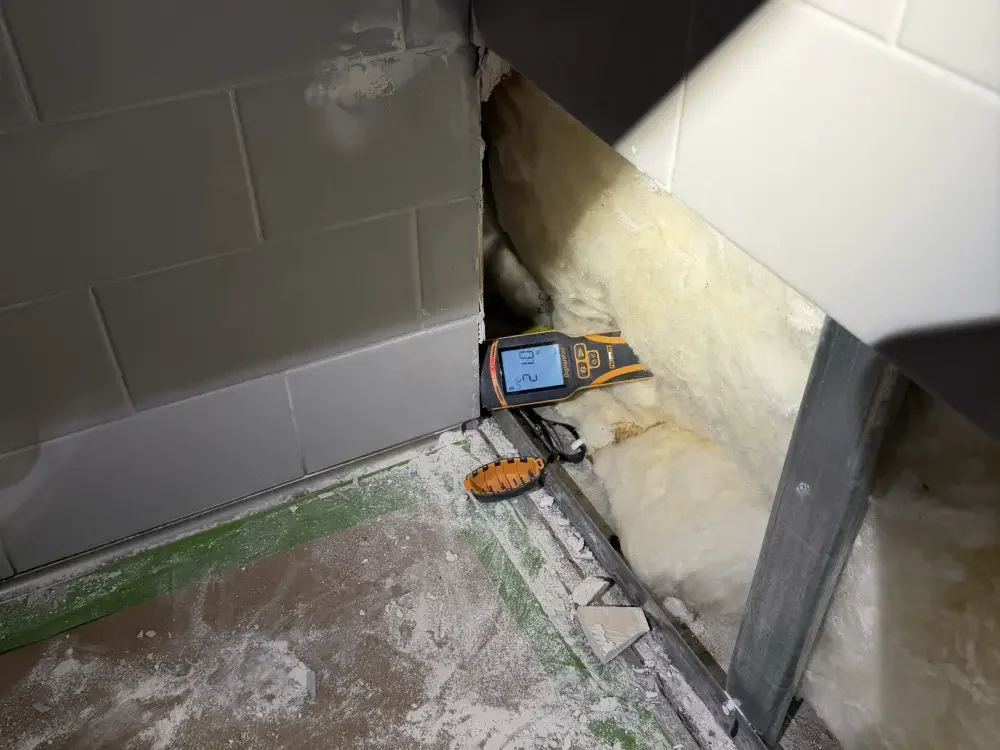
You can’t rely on just a visual inspection, which is why on every project our team uses professional moisture inspection tools. A Protimeter SurveyMaster moisture meter allowed us to take both noninvasive and pin-based moisture readings to find wet materials. We’d then document the drying progress to ensure progress was made and for insurance as well. We also used a Tramex Moisture Encounter meter to scan floors and other building materials for signs of moisture without having to punch through the ground or just assume that it’s dry because it looks dry.
We also walked through the property using a FLIR E6 thermal-imaging camera, which pointed us toward wet areas behind or beneath finished surfaces. We also monitored indoor temperature and relative humidity with an Extech humidity and temperature pen so we could track drying conditions throughout the project.
With a loss this size, it’s important to slow down just enough to make a smart plan, but not so much that the damage continues to spread. That balance is one of the reasons experience matters on large commercial restoration projects, especially when you're juggling the property owner, the fire department, a large crew, affected workspaces, containment needs, and drying conditions all at once.
Water Extraction, Containment, and Air Control
The first major step was extracting water from the warehouse.
Sprinkler water can spread fast in a large commercial building. Our team used water vacuums and extraction equipment to begin removing as much water as possible from the affected areas.
At the same time, we started moving people, furniture, and contents out of the affected office areas. This helped protect belongings from further damage and gave our crew room to work.
The early mitigation work included:
Moving furniture and contents out of affected office areas
Clearing work zones
Protecting areas that were not affected
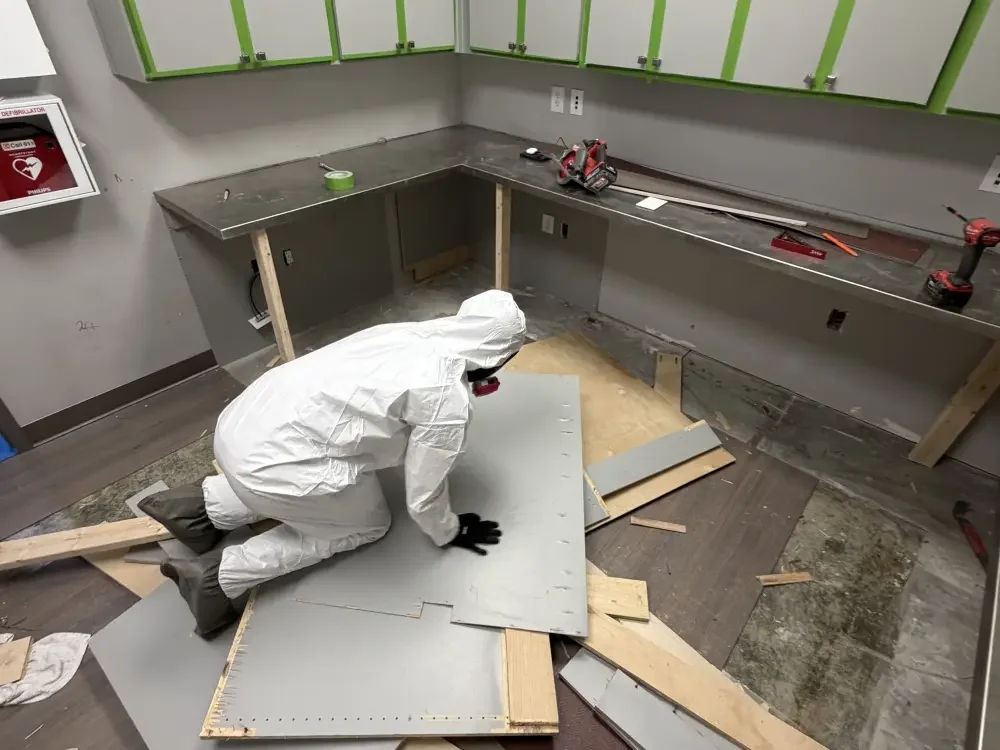
Removing damaged vinyl plank flooring and carpets where needed
Removing kitchen cabinets in an orderly fashion so they could be reinstalled later
Performing two foot high flood cuts where necessary
Setting up drying equipment
Preparing the building for fire and smoke treatment
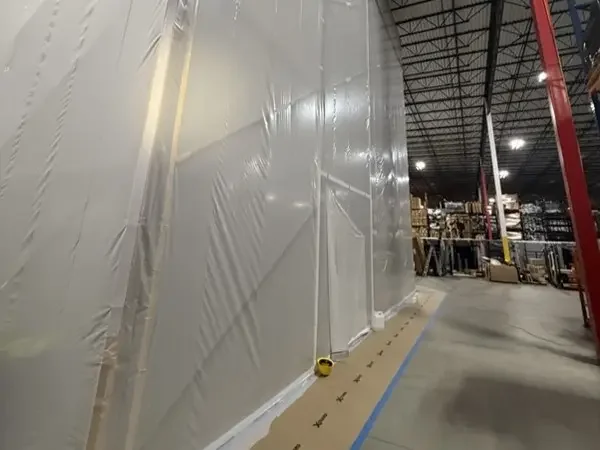
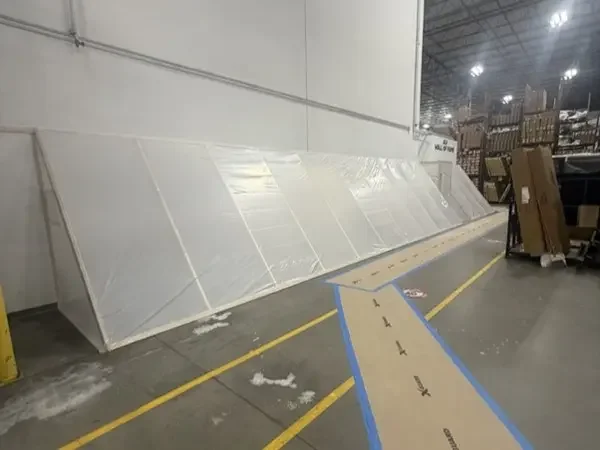
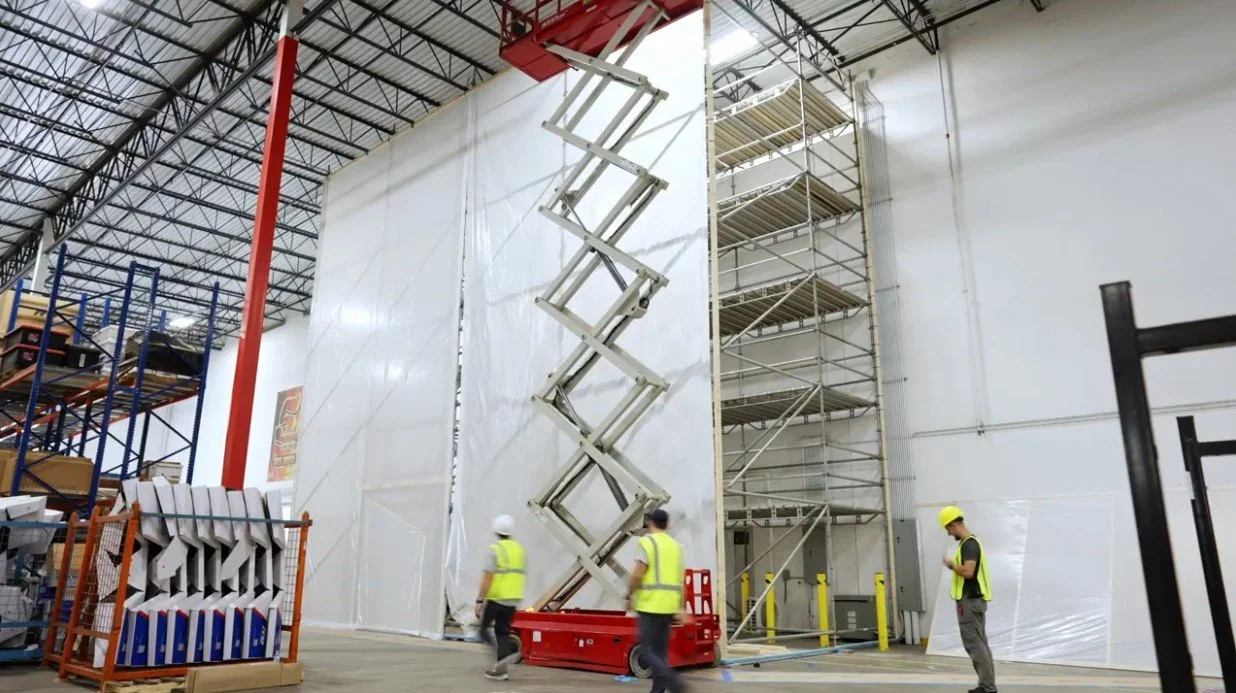
Once extraction was underway, we began setting up temporary containment barriers using heavy plastic sheeting, support poles, tape, and sealed entry points. These containments helped isolate affected sections of the warehouse, protect cleaner areas, and keep dust, debris, and airborne particles from spreading into occupied or unaffected spaces.
We also used air ducting to direct filtered air out of contained areas and help create controlled negative pressure where needed. That is a major part of keeping a large commercial job organized because it helps control airflow instead of letting smoke residue, dust, and contaminants move freely through the building.
Because the loss affected both warehouse and office areas, the work had to be organized carefully so that business operations could still go on while our team continued to work. We needed to move quickly, but we also needed to keep the job controlled so the damage wasn’t spread into areas that didn’t need to be disturbed.
Custom Containments and Demolition
Once water extraction was underway, our team began setting up custom-built containments throughout the building, including a huge multi-story containment system in the warehouse. The golf cart was located near a warehouse wall, so the water sprinklers soaked through that wall, requiring the drywall to be completely removed.
Containments help isolate affected areas so that business operations can still continue, as well as control airflow, improve drying conditions, protect clean areas, and support odor treatment.
In the affected office areas, our team removed damaged flooring and performed flood cuts where needed.
A flood cut is when the lower portion of drywall or wall material is removed because water has reached that area. This allows the wall cavity to dry properly instead of trapping moisture behind the wall. It can look like an unnecessary step, but in many water damage situations, it is the right step because wet materials that stay hidden can continue creating problems later.
The surface may look manageable, but moisture can still be trapped behind walls, under flooring, and inside materials that need to be opened up or removed.
Commercial Drying, Air Filtration, and Smoke Odor Control
A project this large required more than basic fans and standard cleanup equipment.
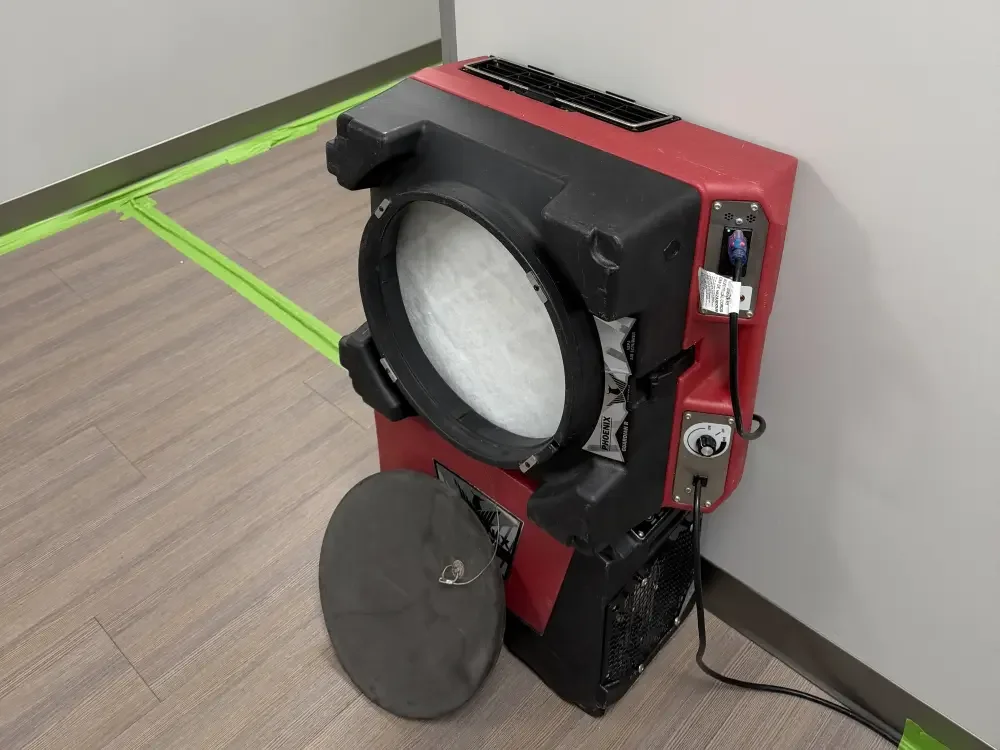
Provision used commercial-grade drying, filtration, odor control, and moisture detection equipment throughout the project. That included Phoenix LGR commercial dehumidifiers, Phoenix AirMAX low-profile air movers, Phoenix Guardian HEPA air scrubbers, air filtration devices, hydroxyl odor control machines, and Titan 4000 hydroxyl machines.
The Phoenix LGR commercial dehumidifiers removed large amounts of moisture from the air, which helped accelerate structural drying and reduce the risk of secondary damage. On a large water loss, drying the air is just as important as drying the visible surfaces because wet materials continue releasing moisture into the environment as they dry.
The Phoenix AirMAX low-profile air movers directed high-velocity airflow across wet floors, walls, and exposed framing. This helped moisture evaporate more quickly so the dehumidifiers could pull that moisture out of the air.
For air quality, our team used Phoenix Guardian HEPA air scrubbers and negative-air machines to filter airborne dust, smoke residue, and fine particles inside the work areas. This was especially important because the project involved both sprinkler water and smoke damage. Air filtration helped keep the work environment more controlled while the team performed demolition, drying, and smoke treatment.
We also used hydroxyl machines, including Titan 4000 units, for odor control. Smoke odor can remain in the air and settle into surfaces long after the fire itself is out, so odor treatment had to continue beyond the initial weekend mitigation. That’s why the urgent water damage work was completed over the weekend, while fire and smoke treatment procedures continued for approximately two weeks.
Other equipment and materials used on the project included:
Water vacuums for extraction
Temporary containment barriers
Lay-flat air ducting
Multi-story scaffolding
Scissor lift
Floor-protection board
Fire and smoke cleaning supplies
Moisture meters
Thermal imaging camera
Humidity and temperature monitoring tools
The scissor lift gave our technicians safe access to high warehouse walls, ceilings, and elevated containment areas. Temporary floor-protection board helped protect unaffected concrete and finished flooring from equipment traffic, debris, and additional damage during the restoration process.
This is where Provision’s large-loss experience really matters. A warehouse like this cannot be handled the same way as a small room in a house. Here, you’re dealing with height, vast square footage, equipment access, safety, airflow, odor control, fire residue, moisture documentation, and business disruption all at the same time.
The right equipment matters, but it only works when the team knows how to use it correctly. On this project, our crew of twenty specialists used that equipment as part of a coordinated plan to extract water, control the work environment, dry the structure, filter the air, treat smoke odor, and keep the project moving through the weekend.
A 20-Person Weekend Mitigation Project
Provision had 20 employees involved in this project.
That size of team made a major difference. The call came in on a Friday afternoon, and the urgent mitigation work was completed over the weekend while their office staff was away, from Friday evening through Sunday.
For a 100,000-square-foot affected area, that required a coordinated effort from every part of the team. Water extraction, furniture moving, office protection, demolition, containment setup, drying equipment placement, warehouse separation, and fire and smoke treatment all had to happen quickly and in the right order.
That kind of weekend response is one of the reasons the customer was so appreciative. A project like this could have dragged out quickly if the response was slow or understaffed. Instead, Provision arrived quickly, brought the manpower needed, and worked through the weekend to get the urgent mitigation under control.
The smoke and fire treatment procedures then continued for approximately two weeks after the urgent work was completed.
Since these are full-time employees and not subcontractors, Provision is able to quickly respond and effectively complete projects on time, with everyone having undergone the same training and used to cohesively working with the same people. At the same time as this project, we were able to continue with other team members on other ongoing projects without limiting our abilities anywhere. That’s the power of the large, well-oiled machine that we’ve built here at Provision.
Weekend Emergency Response to Treatment Completion
The most urgent mitigation work was completed over the weekend.
The project timeline included:
Friday afternoon call
Escalation to upper management
Response within 90 minutes with a large team
Coordination with the warehouse owner and fire department
Immediate water extraction
Moving people, furniture, and contents from affected areas
Custom containment setup
Flooring demolition where needed
Flood cuts where needed
Drying equipment setup
Large warehouse containment installation
Multi-story containment construction
Fire and smoke treatment of walls, ceilings, and affected surfaces
Continued smoke and fire treatment for approximately two weeks
The weekend work helped stabilize the property quickly and gave the customer a clearer path forward after a stressful and disruptive event.
Business Owner’s Complete Satisfaction
The business owner was extremely pleased with how the entire process played out. They complimented our team on the response time and how quickly we were able to complete the urgent mitigation work over the weekend so that their staff could get back to work on Monday.
For a business owner, that matters massively. They appreciated that Provision arrived quickly, brought a large enough team, and worked through the weekend to get the most urgent work completed. That kind of response helped reduce the stress of the situation and gave the owner confidence that the project was being handled properly and that their staff could safely return to work quickly.
Why Commercial Fire and Water Damage Requires the Right Team
A fire inside a warehouse creates several problems at the same time.
Even when the sprinkler system works properly, the water used to control the fire can affect floors, walls, offices, contents, and equipment. Smoke can also travel well beyond the original fire area and leave odor or residue on walls, ceilings, and other surfaces.
A large commercial loss like this one can’t be handled by any restoration company. It needs a company that can handle the entire situation as one organized process, with enough professional manpower and commercial-grade equipment to get it done correctly and quickly.
Provision Property Restoration provides commercial property mitigation and restoration services throughout Gainesville and the surrounding Atlanta area, including Sugar Hill, Lawrenceville, Alpharetta, and beyond.
When a warehouse, office, or commercial facility experiences fire, smoke, or sprinkler water damage, fast response can make a major difference. The sooner the property is stabilized, the better chance the business has of reducing damage, limiting disruption, and moving toward recovery.
If your warehouse, office, or commercial building needs emergency fire or water damage restoration in the Atlanta area, call Provision Property Restoration today at 678-383-0889.